Construction/Contracting AI RL Environment (Crane Lift Demo & Unreal Engine)
The first lift
The first lift
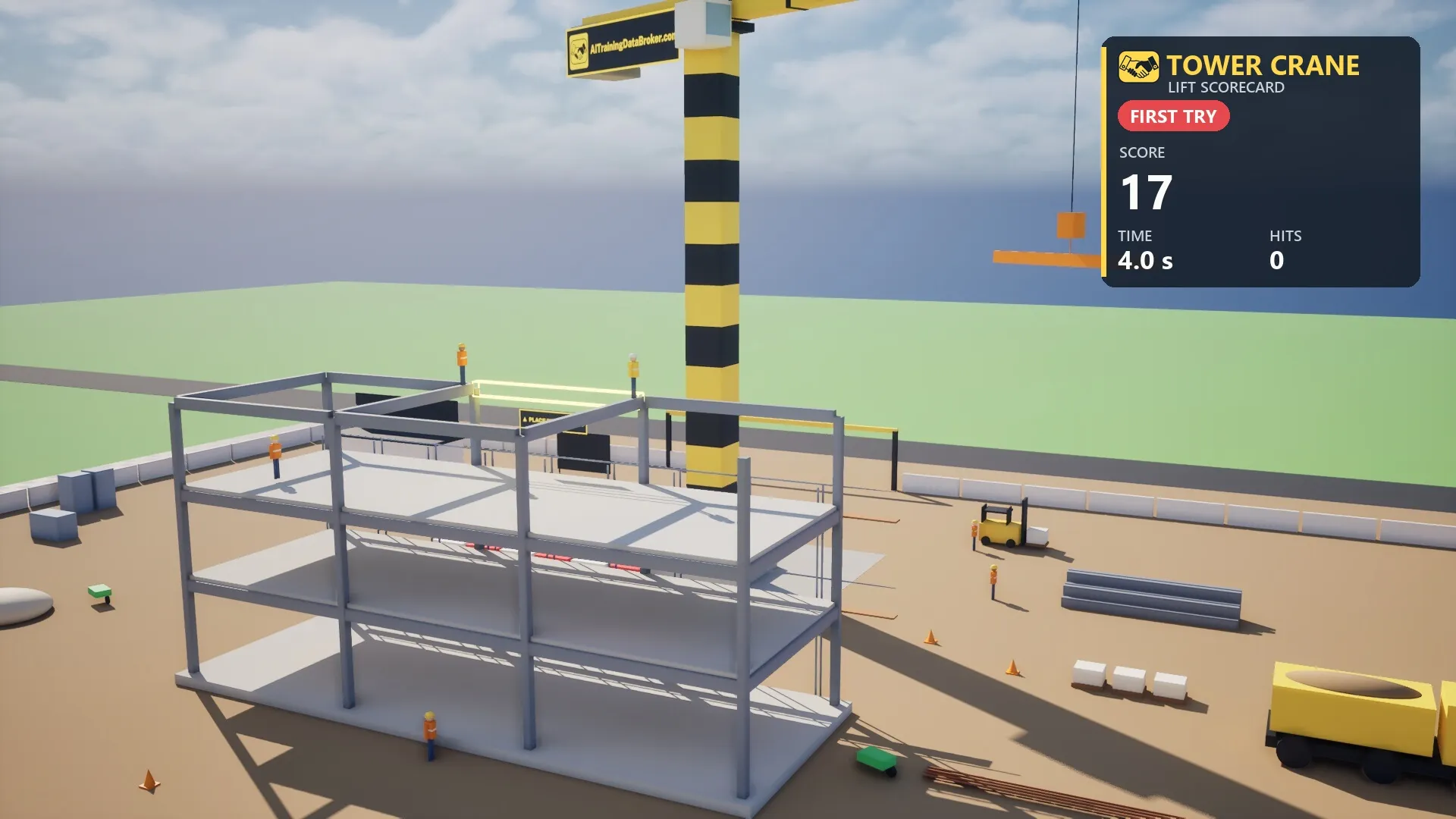
A tower crane has one job today: set the last steel beam, almost 8 metres long, into the top floor.
First try. It swings too fast, and the beam lands on the frame.
On a real site, that is a dangerous day. Here, nobody gets hurt.
The video
Full script
A tower crane has one job today: set the last steel beam, almost 8 metres long, into the top floor.
First try. It swings too fast, and the beam lands on the frame.
On a real site, that is a dangerous day. Here, nobody gets hurt.
Today we look at a construction RL environment, built in Unreal Engine, where a crane learns one lift by practice.
One note before we start: this job site is a demo, made for this video.
A real one would need more training and a contractor's own data.
Before the demo, a word about money.
Every lift costs something: the crane, the operator and the crew are all paid by the hour.
A beam set in the wrong place has to come down and go up again.
And a swinging load near people can stop the whole site.
So why would a contractor build its own RL environment?
To test a lift plan before the crew shows up, and try it 1,000 ways for free.
It is not about replacing the operator. It is about a better plan before anyone climbs the crane.
Here is the same lift 3 times: the first try, one practice run, and the run after practice.
The point is to save time and money on lifts you do every week.
AI labs want the same thing, on a bigger scale.
They build practice worlds so AI agents can learn physical work.
To make those worlds real, they need the order a job really happens in, the mistakes that happen, and the plans behind it.
That is construction data, and contractors are the ones who have it.
Here is the site: a 3-floor steel frame, a tower crane and a stack of beams.
The top floor is almost done: the yellow outline marks the one beam still missing.
That spot comes from the CAD drawing the crew builds from.
In a real environment, your own drawings decide where every piece goes.
RL means learning by reward: software learns a task by trial and error, and every try gets a score.
So how is a lift graded?
Moving the beam closer earns points, and so does turning it to fit the gap.
A hit costs 30, and a load that swings too far costs points too.
These rules are called a reward function, written once in code, and the contractor decides what a good lift means.
Now watch it practise, sped up, from above.
Some tries stop short, some hit the frame, and some set the beam at the wrong angle.
Each try is scored, and the next one does a little better.
After practice, the same lift looks very different.
It picks the beam up gently and turns it on the way over.
The swing stays small, and it comes straight down into the gap with zero hits.
Beam in place. Full points, and the crew can bolt it in.
This is not only a video idea.
Researchers at the University of British Columbia trained a robot-run crane inside a simulator.
In 4 simulated job sites, it set its load with no collision more than 97% of the time.
Source: Journal of Civil Engineering and Management, December 2025.
Now the honest part.
These runs were set up for the video.
A game never matches real wind, ground and rigging, unless it is built from real job data.
Even then, it is tested step by step before anyone trusts it on site, and it will not fit every job.
You might be asking: what about your company's own data?
You can keep it and run a private environment on your own servers.
Or you can license it to an AI lab.
Then it is de-identified first, and the contract limits how the lab may use it.
You keep your own copy, and anything that cannot be licensed is left out of the deal.
To start, pick one lift you repeat and gather the lift logs and site photos you already keep.
I'm Jimmy. I have worked in data at Fortune 500 companies, as a data analyst, a data engineer and a software engineer, and I am trained in data science. I am also a Canadian military veteran, specialized in data analysis and reporting.
If you want to sell your data, I am your broker and technical advisor. I bring your data to several AI companies, and I guide your team through the technical side, including compliance. AI companies pay my fee.
Already shopping your data around? Contact us anyway. We can still work through the terms with you and help you negotiate a better price.
If you are buying data for an AI lab, I find the right data and see it through to delivery, so you can focus on AI research.
A crane lift is only one example; every job you repeat leaves a trail of data.
Learn how licensing works at AITrainingDataBroker.com.
Which lift on your site would you train first? Tell me in the comments.
Thanks for watching, and see you in the next one.
More slides
The first try
AITrainingDataBroker.com
Can a company build
its own RL environment?
RL = reinforcement learning. Will it save time and money?
3 parts: the payoff · the risk · how to build oneJimmy Lin
AITrainingDataBroker.com
How much money did
companies get for
selling data to AI?
What the filings say Reddit, Wiley, Informa and HarperCollins were paid, and what that means for your data
Jimmy Lin