Manufacturing/Factory AI RL Environment (Robot Arm Demo & Unreal Engine)
The first pick
The first pick
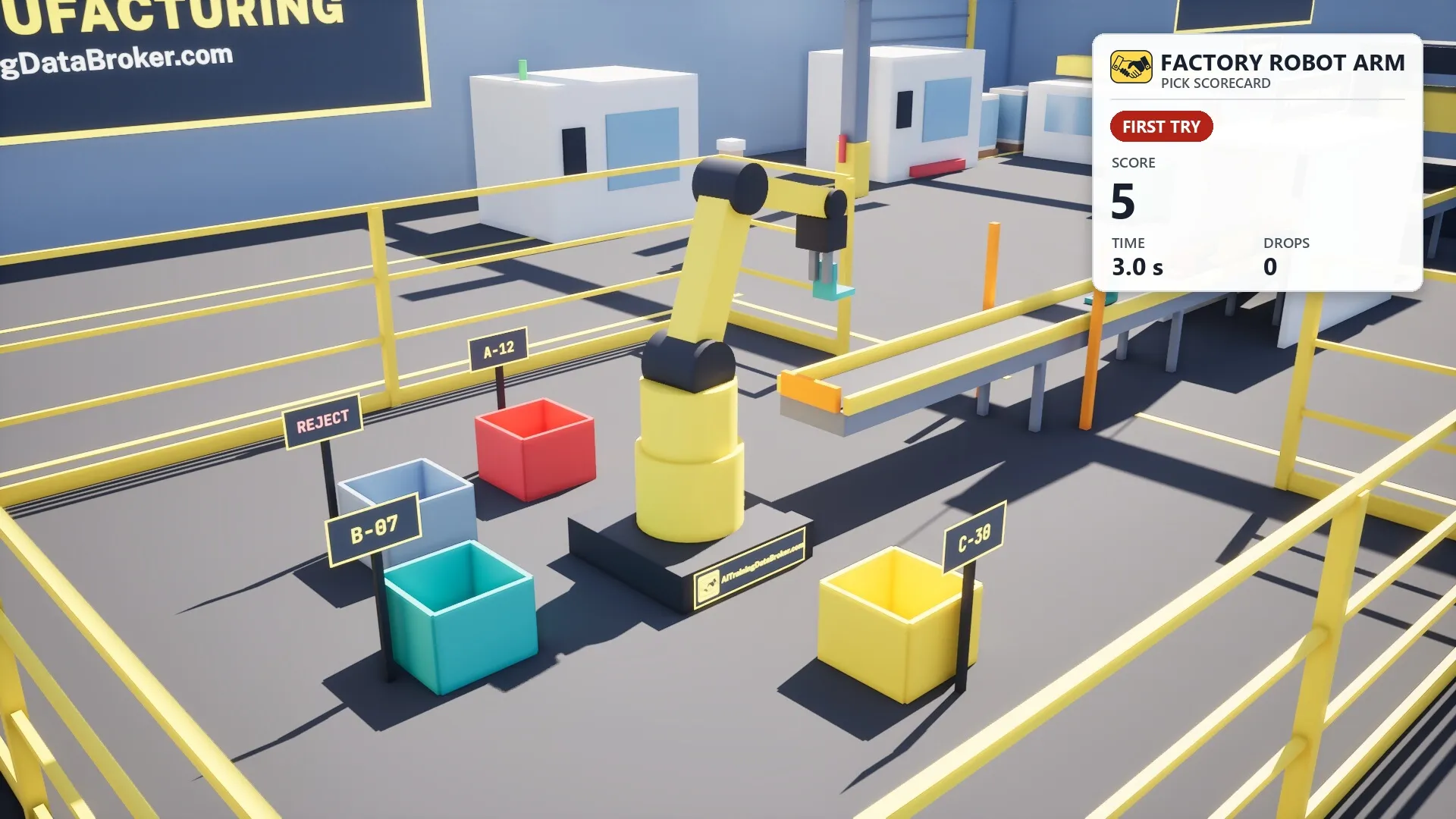
A robot arm on line 2 has one job: sort 3 kinds of steel bracket into the right bins.
First try. It grabs the bracket off centre, swings too fast, and drops it on the floor.
On a real line, a dropped part is scrap, and it can stop the whole cell.
The video
Full script
A robot arm on line 2 has one job: sort 3 kinds of steel bracket into the right bins.
First try. It grabs the bracket off centre, swings too fast, and drops it on the floor.
On a real line, a dropped part is scrap, and it can stop the whole cell.
This is a manufacturing RL environment, built in Unreal Engine, where a robot arm learns one job by practising it.
Before we go on: this factory is a demo, made for this video.
A real one would be built from a manufacturer's own parts and data.
First, why a factory owner would care.
When a line stops, it makes nothing, and every minute shows up on the cost report.
A new part means teaching the robot again, often while the line waits.
And every dropped or mis-sorted part ends up as scrap.
Inside a simulator, the robot can learn before it touches the real line.
It can practise a new part overnight, thousands of times, while production keeps running.
Here are 3 runs side by side: the first try, one practice run, and the run after practice.
Most people think the hard part is the robot. It is actually the teaching, and that is where the time and money go.
AI labs are building practice worlds for factory work too.
To make them realistic, they need what only a manufacturer has.
That means the CAD drawing of every part, how parts are really handled shift after shift, and the scrap and quality logs.
That data already sits in a factory's own systems.
This is our line: steel sheets are cut, bent into brackets, powder coated, and sent to the robot cell.
The robot sorts each bracket into its bin by part number.
Its instructions come from the CAD drawing on that screen, the same file the factory builds from.
In RL, software learns by reward: it tries, gets a score, and adjusts.
Each pick earns points for a clean grip and for the right bin, plus 20 when the bracket lands.
A drop costs 30, a wrong bin costs points, and a slow pick costs a little.
These rules are the reward function, and the factory sets them to match its own goals.
Watch the practice from above, sped up.
One try drops the bracket, another puts it in the wrong bin, another is too slow.
Every try is scored, and the scores slowly climb.
After practice, the arm grips each bracket cleanly and moves without a wasted motion.
Red to A-12, teal to B-07, yellow to C-30.
3 picks, 0 drops, full points.
Here is what researchers found when they tried this.
A team at the Karlsruhe Institute of Technology trained a grasping robot in a simulator first.
On its own, the simulator got it to about 70%.
Then they showed it just 40 real examples from the robot cell, and success rose to 96.7%.
Source: IEEE Robotics and Automation Letters, April 2025.
Here is the honest part.
A grey bracket the robot has never seen comes down the line, and its grip slips.
These runs were set up for the video, and a simulator only knows the parts it was built with.
That is why a real one starts from the factory's own CAD files and is tested step by step on the real cell.
And it will not fit every product.
You might be asking: what about your company's own data?
One path is to keep it and train your own robots in a private simulator, on your own servers.
The other is to license it to an AI lab: it is de-identified first, and the contract limits the use.
You keep your copy, and anything that cannot be licensed is left out of the deal.
A good first step: pick one part you make every week, and gather its drawings and handling logs.
I'm Jimmy. I have worked in data at Fortune 500 companies, as a data analyst, a data engineer and a software engineer, and I am trained in data science. I am also a Canadian military veteran, specialized in data analysis and reporting.
If you want to sell your data, I am your broker and technical advisor. I bring your data to several AI companies, and I guide your team through the technical side, including compliance. AI companies pay my fee.
Already shopping your data around? Contact us anyway. We can still work through the terms with you and help you negotiate a better price.
If you are buying data for an AI lab, I find the right data and see it through to delivery, so you can focus on AI research.
A robot arm is one example; every repeated job on a factory floor leaves data behind.
Learn how licensing works at AITrainingDataBroker.com.
Which part on your line would you train a robot on first? Tell me in the comments.
Thank you for watching, and see you next time.