Warehouse AI RL Environment: Self-Driving Forklift Demo (Unreal Engine)
The first try
The first try
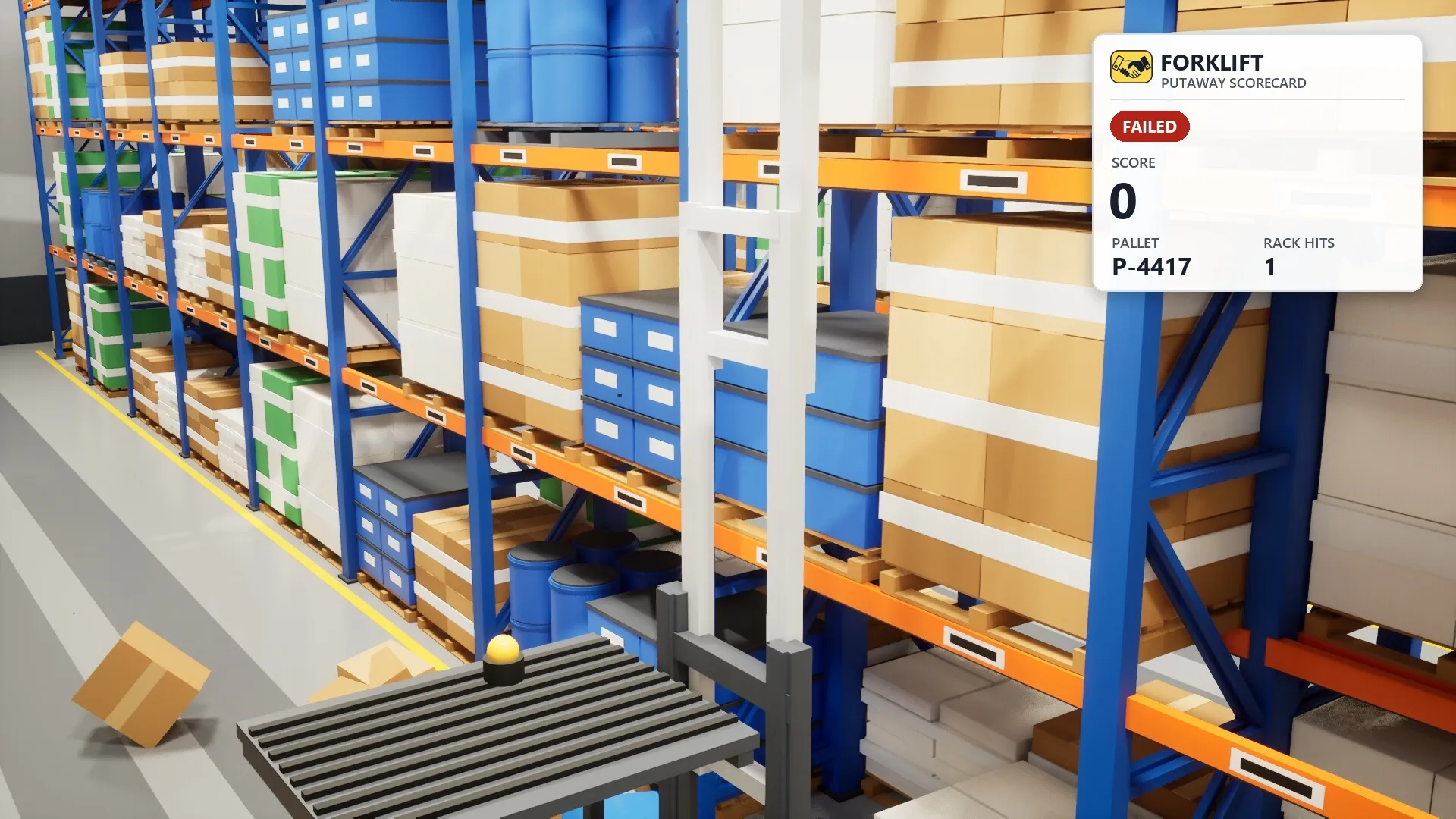
Pallet P-4417 has to go up to the top shelf of aisle 2.
First try. The forklift raises its forks too late, and the load hits the rack.
Cartons spill across the aisle, and on a real floor that is a safety incident.
The video
Full script
Pallet P-4417 has to go up to the top shelf of aisle 2.
First try. The forklift raises its forks too late, and the load hits the rack.
Cartons spill across the aisle, and on a real floor that is a safety incident.
This is a warehouse RL environment, built in Unreal Engine.
In it, a forklift learns to put a pallet on a high rack shelf.
One thing first: this warehouse was made for this video.
A real one would be built from a company's own floor and data.
First, why a warehouse would care.
Forklifts are everywhere, and they are risky.
OSHA estimates roughly 85 deaths and 34,900 serious injuries a year in forklift incidents.
A dropped pallet wrecks the goods, and it can bend a rack upright.
And a pallet that misses its slot goes around again while the next truck waits.
In a simulator, the forklift can rehearse the lift long before it goes near a real rack.
It can try thousands of times, and nothing gets dropped.
Here is the same pallet 3 times: the first try, one practice run, and the run after practice.
The forklift itself is the easy part to buy.
The hours go into teaching it, and rehearsing in a simulator makes those hours cheaper.
AI labs are building practice worlds for warehouse work, and a warehouse's own data makes those worlds realistic.
That means pick and putaway logs, the layouts and slot maps, and the incident and near-miss reports.
Most of that already sits in the warehouse system and the safety binder.
Our warehouse has 5 dock doors, 3 aisles of racks, each 15 bays long, and a staging area by the docks.
On the wall is the putaway list: pallet P-4417 goes to slot C-03-3.
A real warehouse keeps that same list in its warehouse system, line by line.
It is part of what makes a practice world feel real.
In RL, software learns from a reward: it tries, gets a score, and adjusts.
Here it earns points for each step toward the slot: picking up, driving to the aisle, lining up, and lifting to the right height.
Another 20 points come when the pallet sits in the slot.
A hit on the rack costs 30, a dropped load costs 50, and a slow trip costs a little.
Those rules are the reward function, and the warehouse sets them to match its own priorities.
Watch the practice, sped up.
One try scrapes the rack, one drops the load, and one seats the pallet.
Every try gets a score, and the best score keeps climbing.
After practice, the forklift raises the forks while it drives, so they are at the right height when it arrives.
Then it turns into the aisle bay, slides the pallet in and sets it down.
Slot C-03-3, 0 hits, full points.
Now, what researchers found.
Koshi Oishi and colleagues trained a forklift in a simulator, with no real-world data.
Then they tried it on a small robotic forklift, one fourteenth of full size, with no extra training.
It loaded pallets 60% of the time.
That is not perfect, and it is not a full-size truck, but it shows what practice in a simulator can carry over.
Source: ICRA 2025.
Now the honest part.
A pallet is left in the aisle, and the forklift simply stops, because it never practised with anything there.
These runs were set up for the video, and a simulator only knows what it was given.
A real one starts from the warehouse's own layout and data, then gets tested slowly on the real floor.
And it will not cover every warehouse.
What about your own company's data?
One option is to keep it, and build a private simulator of your own warehouse on your own servers.
The other is to license it to an AI lab.
It is de-identified first, and the contract sets the limits on how it is used.
You keep your copy, and anything that cannot be licensed is left out of the deal.
A simple place to start: pick your busiest aisle and pull a month of its putaway list and incident reports.
I'm Jimmy. I have worked in data at Fortune 500 companies, as a data analyst, a data engineer and a software engineer, and I am trained in data science. I am also a Canadian military veteran, specialized in data analysis and reporting.
If you want to sell your data, I am your broker and technical advisor. I bring your data to several AI companies, and I guide your team through the technical side, including compliance. AI companies pay my fee.
Already shopping your data around? Contact us anyway. We can still work through the terms with you and help you negotiate a better price.
If you are buying data for an AI lab, I find the right data and see it through to delivery, so you can focus on AI research.
Every pallet that moves through a warehouse leaves a record behind.
More on how licensing works is at AITrainingDataBroker.com.
Which aisle in your warehouse is the hardest to work in? Tell me in the comments.
Thank you for watching, and see you next time.
More slides
AITrainingDataBroker.com
Buy/Sell/License
AI Data Market
Update, Nov 5
Who is buying, what is urgent, and what to do today
Jimmy Lin
AITrainingDataBroker.com
Can a Biotech
Sell or License
Failed Experiments?
3 parts: what a notebook holds · how AI learns from it · who may license it
Jimmy Lin
AITrainingDataBroker.com
AI Labs Want
Lab Notebook Data
Right Now (Nov 4)
An open request for lab notebook data, what it asks for, and what to do today
Jimmy Lin